1 Research Motivation and Questions
The energy security of Taiwan is a well-known concern, and the problem exposes the economy to high price sensitivity and geopolitical risk (Chuang & Ma, 2013). As the Energy Administration’s 2024 report shows, imported energy contributed 95.8% of Taiwan’s total annual energy supply (Energy Administration, Ministry of Economic Affairs, 2024). To reduce energy security risks, the government has promoted energy transition measures since 2016, including a nuclear-free homeland by 2025 and the prioritization of renewable energy development. In 2021 the administration formally launched the Net Zero Transformation Action Plan targeting 2050 (Climate Change Administration, Ministry of Environment, 2022).
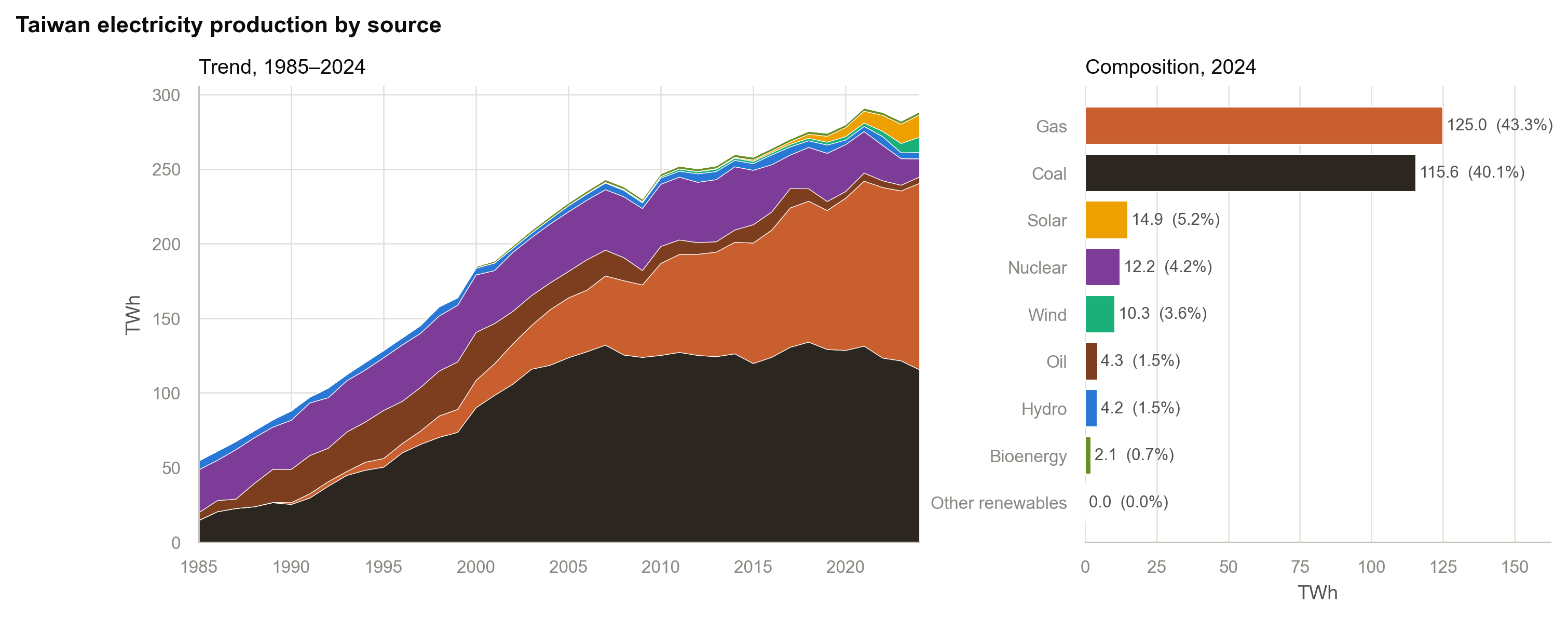
As of 2024, Taiwan’s electricity production remained dominated by fossil fuels at 84.9%, while renewable energy had grown to 10.9% and nuclear power had declined to 4.2% (Ritchie et al., 2026). Figure 1.1 shows the trend of electricity production and the sectoral shares in 2024.
This study addresses the core question: does renewable energy development effectively reduce fossil fuel import dependence in Taiwan? The question is not rhetorical. The official import-dependence indicator has indeed fallen, from an annual mean of 97.8% in 2000 to 95.7% in 2024 and 94.8% by January 2026, as Figure 1.2 shows.
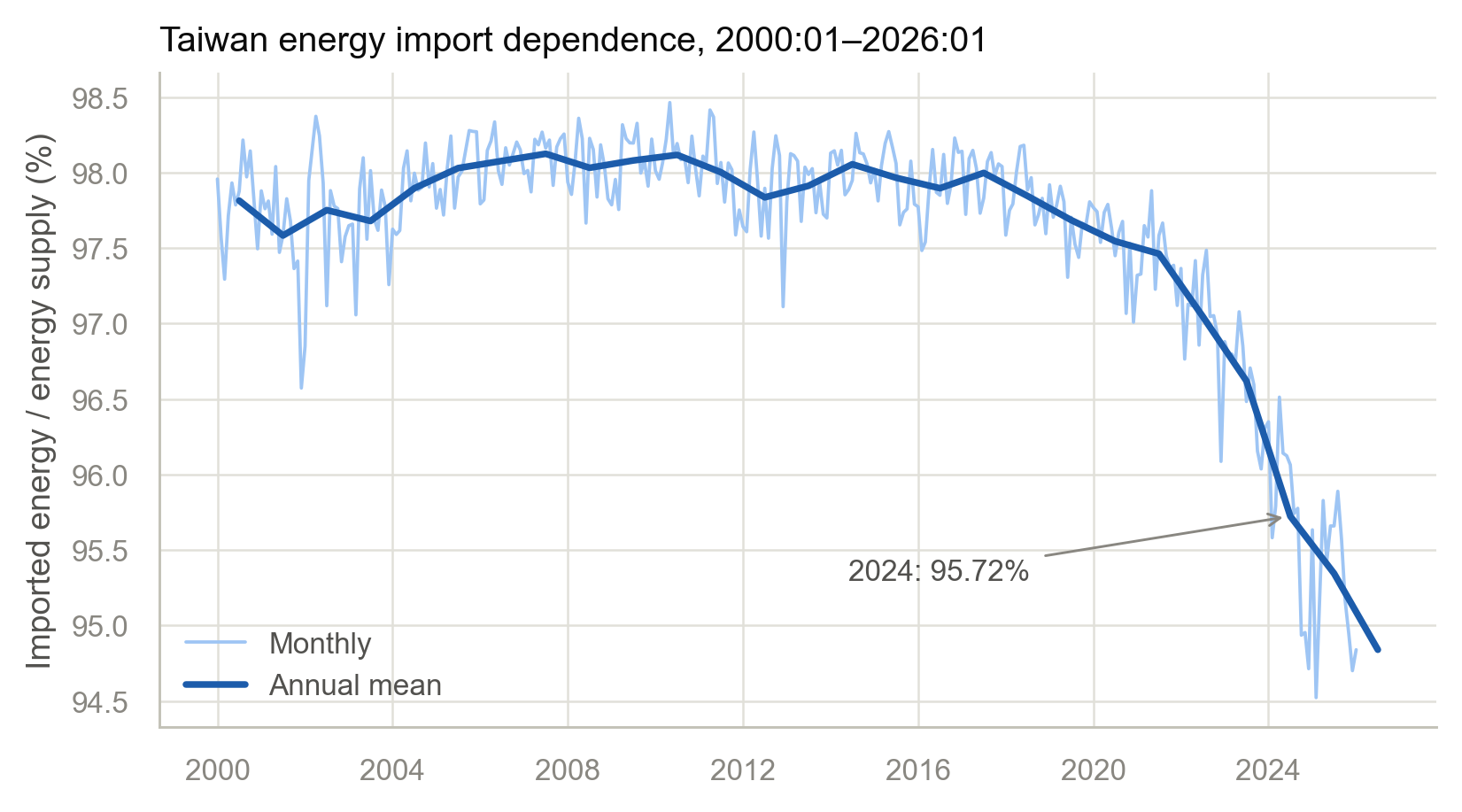
That decline is nevertheless a poor test of substitution, because the indicator is a ratio whose denominator includes domestic renewable supply — renewable expansion mechanically lowers it whether or not a single tonne of imported coal is displaced. Establishing displacement requires estimating the response of the quantity of fossil fuel imported to renewable generation, holding demand and the competing supply sources constant. That is the task the rest of this book takes on.