2 Literature Review
Because Taiwan-specific evidence on the energy transition is limited, this chapter assembles global cases with empirical evidence in order to identify the potential risks and problems along Taiwan’s transition path.
2.1 The persistence of fossil fuel dominance in global power generation
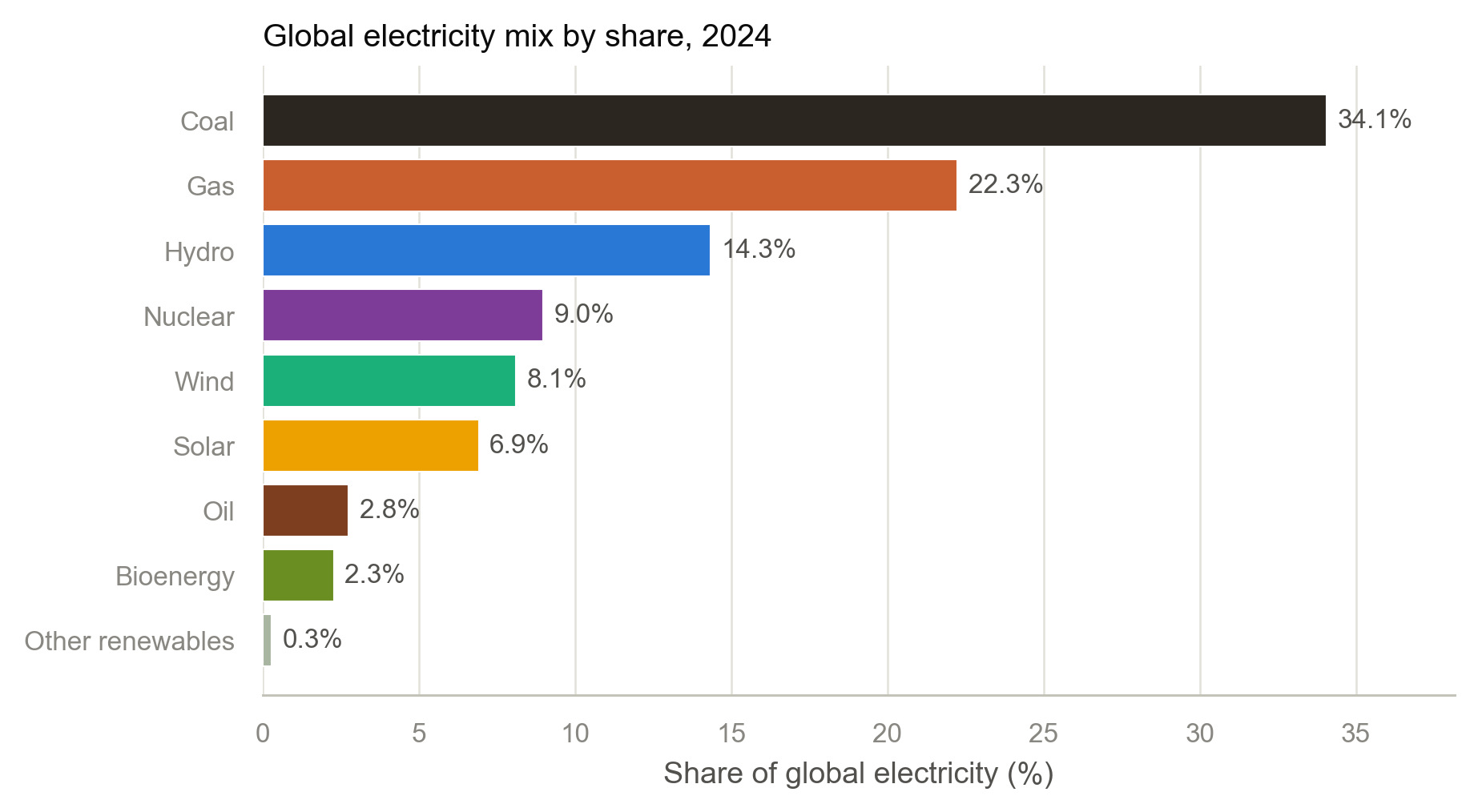
Globally, the energy structure remains heavily reliant on fossil fuels. As of 2024, coal and natural gas together accounted for over 56% of total electricity generation, with coal alone contributing 10,544 TWh — more than double the combined output of wind and solar power (Ritchie & Rosado, 2026). Figure 2.1 shows the worldwide energy mix and its shares in 2024.
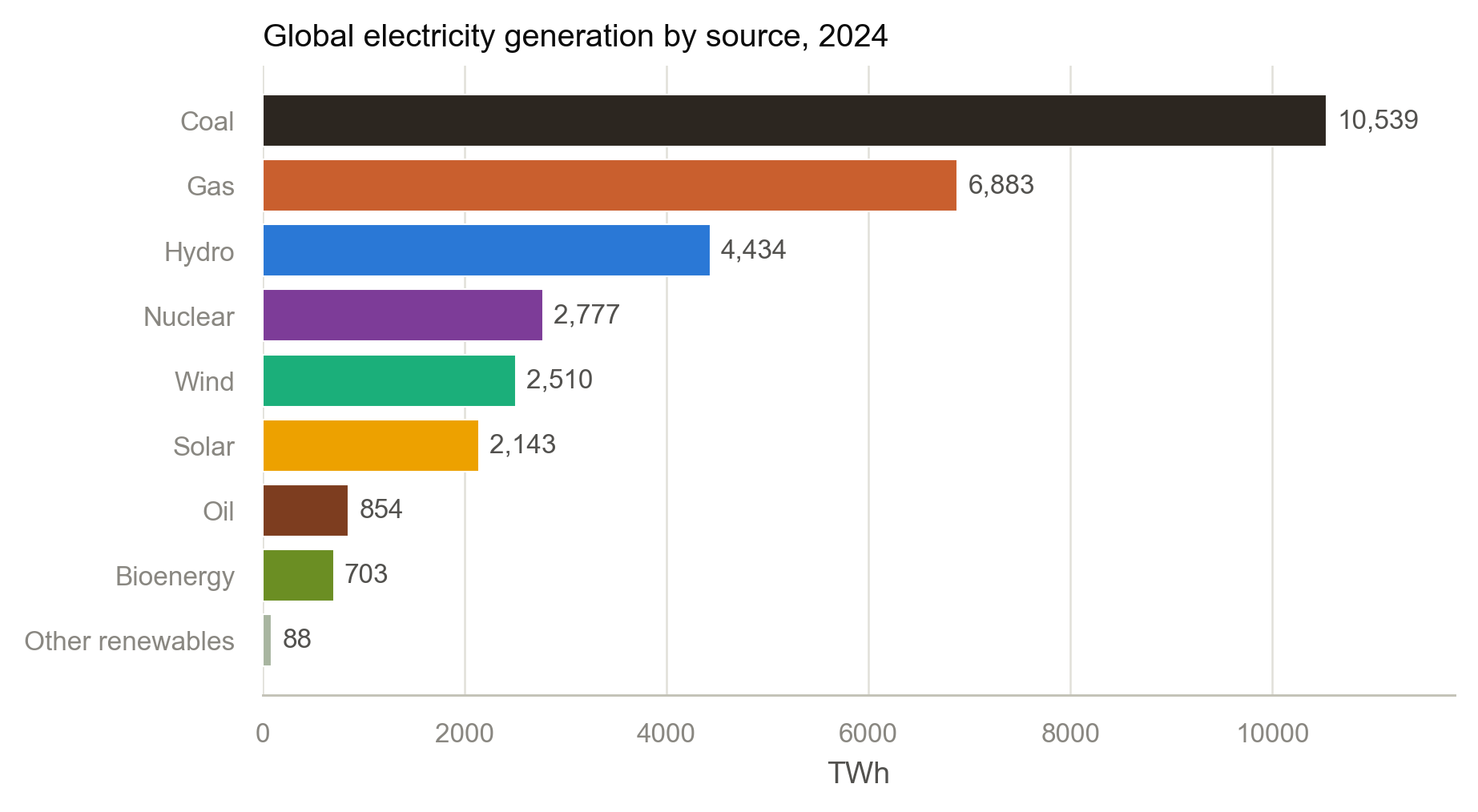
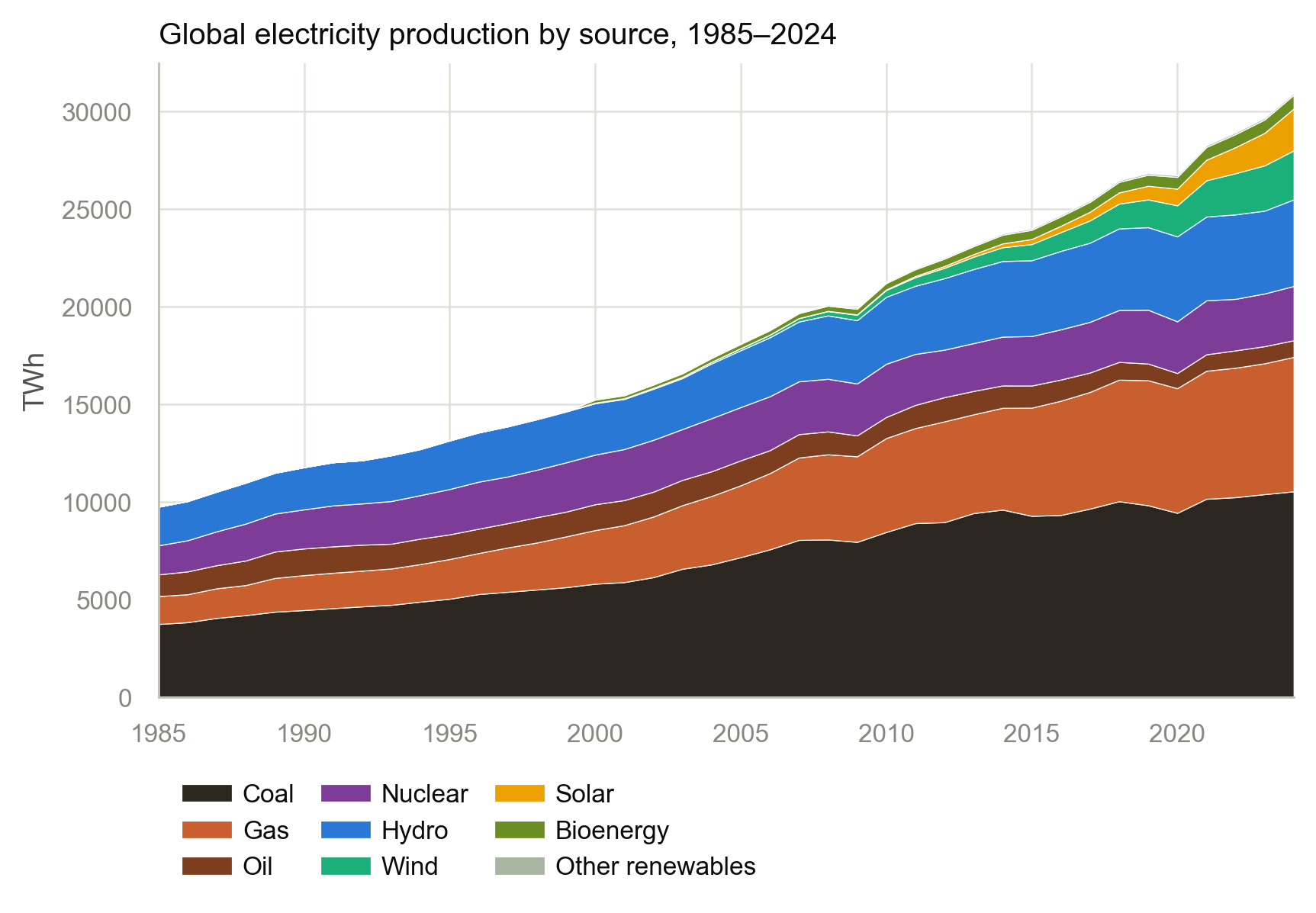
While renewable energy has seen exponential growth — solar generation more than doubled from 857 TWh in 2020 to 2,128 TWh in 2024 — this capacity expansion has largely functioned to meet rising global demand rather than displacing existing fossil fuel assets. Coal generation actually increased by over 1,100 TWh during the same period, illustrating that the global trend is currently one of energy addition rather than genuine energy transition. Figure 2.2 shows the worldwide electricity production trend by energy source from 1985 to 2024.
This global persistence of fossil fuel dependence highlights a critical gap between policy ambition and empirical reality. If global markets with their diverse resource endowments struggle to achieve a substitution effect, the challenge is likely more acute for isolated, import-dependent economies. Indeed, Jacobson (2021) finds that in the absence of cross-border interconnection, maintaining grid stability under high renewable penetration requires disproportionate investment in storage and capacity overbuilding, leading to significantly higher aggregate costs. This motivates a careful examination of whether renewable energy expansion can effectively reduce energy supply from fossil fuel imports in national contexts such as Taiwan.
2.2 The empirical reality of substitution effects
Theoretically, the near-zero marginal cost of renewables prioritizes them in the dispatch order, potentially displacing fossil fuel generation. Seminal empirical work by York (2012) investigated this assumption and revealed a “fractional displacement” reality in which one unit of non-fossil electricity displaces significantly less than one unit of fossil-fuel-based electricity — in fact, less than one-tenth of a unit. York’s findings indicate that the displacement coefficient is often far below unity, implying that the majority of renewable capacity is absorbed by consumption growth or system inefficiency rather than by retiring fossil fuel plants.
Karlilar Pata & Balcilar (2024) estimate an imperfect displacement of fossil-fuel generation capacity by renewables in 36 OECD countries over 2000–2020: on average, displacing one unit of fossil-fuel capacity requires about 1.15 units of renewable generation capacity, implying less than one-for-one substitution in aggregate.
The mechanism behind this limited substitution lies largely in the intermittency of variable renewable energy. Marques et al. (2018) provide empirical evidence from 10 European countries, showing that dispatchable renewables such as hydropower exhibit strong substitution effects against fossil fuels, while intermittent sources such as wind fail to displace them proportionally. Their European sample also finds a substitution effect for solar PV; this study places solar in the variable-source category consistent with its dispatch profile in Taiwan’s isolated grid, where the cross-border balancing that smooths solar output in the European mainland is absent. This necessitates flexible backup generation, primarily natural gas, to maintain grid stability, thereby perpetuating fossil fuel dependency.
These findings suggest that the “additionality” of renewables is a global phenomenon driven by grid constraints and the technical necessity of backup power. However, most existing literature focuses on continental grids with cross-border balancing capability. The implications for isolated island economies, where grid stability relies entirely on domestic reserves, remain under-explored. This study fills that gap by investigating the substitution dynamics within Taiwan’s isolated and import-dependent energy system, and by testing the dispatchable-versus-variable distinction of Marques et al. (2018) directly in that setting.